M. Onurcan Kaya (卡荣)

Hi, I'm Onur, a final-year PhD student at DTU, graduating in October 2027. I work on test-time self-improvement: helping vision-language models (LLMs that understand both images and text) fix their own mistakes without being told the right answers.

Supervised by Dim P. Papadopoulos and Desmond Elliott. Previously a deep learning engineer in industry; see background.

  • Looking for research internships · Winter / Summer 2027
  • Open to collaborations and supervising student projects

Research focus

After deployment, a vision-language model stops learning. It still meets new images and questions unlike its training data, and when it answers wrong, nobody tells it the right answer: there are no labels. I work on test-time self-improvement: the model uses extra computation to get better on the very questions it is asked, still without labels. There are two ways.

Traditional training

Pre-trainingPost-training

Learning before deployment

Deploymentnew questions, no labels

Test-time self-improvement

Improving after deployment, without labels

Route 1

Improve the model

The model learns from the questions it is asked. Training on its own answers can backfire: when it is wrong, it can learn to stay wrong. In SIMIT, it instead synthesizes its own practice problems, fixing each answer before generating a matching image, and learns from them before answering.

  1. A test question it gets wrong

    A dim, blurry photo of a cat lying on a lap next to a keyboard

    What color is this cat?

    “Unanswerable”(wrong)

  2. It synthesizes related practice problems: the answer first, then an image that fits it

    • A generated photo of a fluffy cat sitting on a lap

      Is the cat sitting or lying down?Sitting

    • A generated photo of a fluffy cat standing on a lap

      How many legs does the cat have?Four

  3. It reads them as worked examples, then answers again

    ?
Fig. 1 Practice makes correct. A real SIMIT example. One model does every step; no labels and no other models are used.

Route 2

Improve the answer

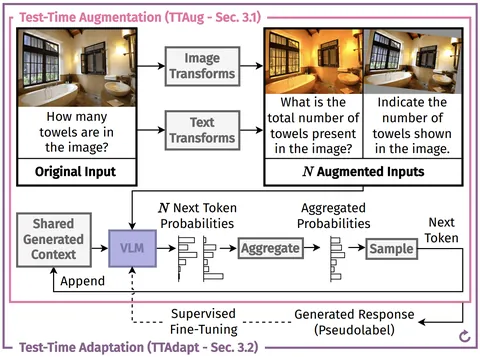
The model stays unchanged. Instead, we show it several altered versions of the input and average its predictions. For small vision-language models, this is more accurate and cheaper than sampling many answers and voting (ICLR 2026).

  1. A test question it gets wrong

    A bar chart of 2018 arrivals in Italy by country, in thousands: Germany 13,518, France 7,641, United Kingdom 5,659, Austria 4,020, United States 3,694

    Which country had the most visitors to Italy in 2018?

    “France”(wrong)

  2. It looks again at 15 altered versions: the image recolored, rotated, blurred or partly hidden, the question with typos

    Hover a version to read its question.

  3. It averages its word predictions over all 16 inputs

    ?

Fig. 2 Look again. A real example from the paper: the original input plus 15 altered versions, with the model's next-word probabilities averaged at every step.

Other research

During my PhD

Precise image editing

In POEM, a multimodal LLM turns an edit instruction into object masks before and after the change, which guide a diffusion model to precise object-level edits. WildLight tests how well AI can relight a real photo to match a target environment map.

InstructionMove the lantern to the left by 120 px.

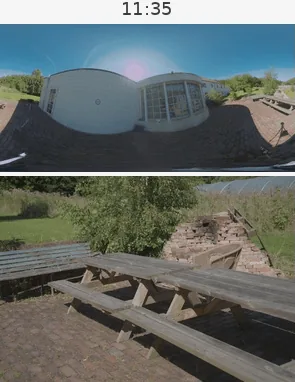
Fig. 3 Two kinds of edits. A real POEM result, edited from a text instruction. In WildLight the target is lighting, given as an HDR environment map captured with each real photo, so relit images can be scored against the real one. Click the photo, or drag the sun.

Before my PhD

Phase retrieval

Recovering an image from only the magnitude of its Fourier transform, with the phase lost, a common problem in microscopy and optical imaging. Classical algorithms depend on where they start. My methods combine several starts and refine them with diffusion models.

MeasuredFourier magnitude

Run 1 

Run 2 

Run 3 

iteration 0
Fig. 4 Classical phase retrieval, live. Fienup's HIO algorithm sees only the Fourier magnitude of my photo and starts three runs from random noise. A run can succeed, get stuck, or find the upside-down twin, which fits the measurement just as well. Noise-free 64×64 simulation; “fit error” compares each run with the measurement only.

Publications

Google Scholar
Filter publications by topic

  1. arXiv 2026

    SIMIT: Self-Improving Vision-Language Models via Imagination at Test-Time

    M. Onurcan Kaya, Desmond Elliott, Dim P. Papadopoulos

    A unified multimodal model synthesizes its own practice problems (answer first, then image) and learns from them: +7.20% mean relative gain over BAGEL-7B, no labels.

  2. ICLR 2026

    Efficient Test-Time Scaling for Small Vision-Language Models

    M. Onurcan Kaya, Desmond Elliott, Dim P. Papadopoulos

    Efficient test-time scaling for small VLMs: token-level aggregation over augmented inputs (TTAug), and adaptation on its consensus pseudo-labels (TTAdapt).

  3. arXiv 2025

    Visual Autoregressive Models Beat Diffusion Models on Inference Time Scaling

    Erik Riise, M. Onurcan Kaya, Dim P. Papadopoulos

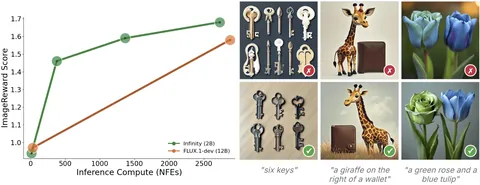
    Discrete tokens make search effective: with beam search, a 2B visual autoregressive model outperforms a 12B diffusion model.

  4. arXiv 2026

    BatchParScale: Sparse Batch-Mixing for Sequence Models

    Hans Peter Lyngsøe Raaschou-Jensen, M. Onurcan Kaya, Desmond Elliott

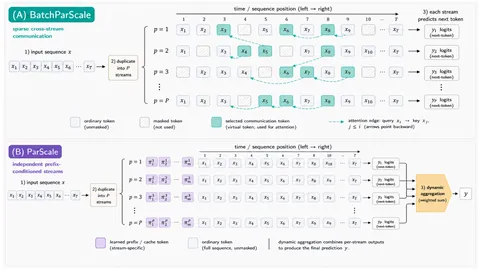
    Parallel copies of a model usually run independently; here they exchange information through a few shared positions, and predict text better than independent copies.

  5. WACV 2026 · OralICCVW 2025 · Oral

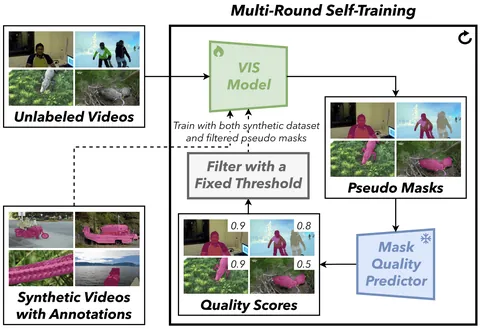
    Boosting Unsupervised Video Instance Segmentation with Automatic Quality-Guided Self-Training

    Kaixuan Lu, M. Onurcan Kaya, Dim P. Papadopoulos

    Self-training with automatic quality assessment of pseudo-labels for unsupervised video instance segmentation: +4.4% over VideoCutLER.

  6. CVPR 2026 FindingsICCVW 2025 · Oral

    WildLight: A Real-World Dataset and Benchmark for Single-Image Relighting

    Lezhong Wang, M. Onurcan Kaya, Siavash Bigdeli, Jeppe Revall Frisvad

    A real-world benchmark for single-image relighting: outdoor scenes under changing natural light with HDR environment maps, exposing the synthetic-to-real gap.

  7. SCIA 2025CVPRW 2025

    POEM: Precise Object-Level Editing via MLLM Control

    Marco Schouten, M. Onurcan Kaya, Serge Belongie, Dim P. Papadopoulos

    An MLLM predicts object masks before and after the edit, guiding a diffusion editor to precise object-level edits. Introduces the VOCEdits benchmark.

  8. IEEE TCI 2026IEEE MLSP 2025 · Oral

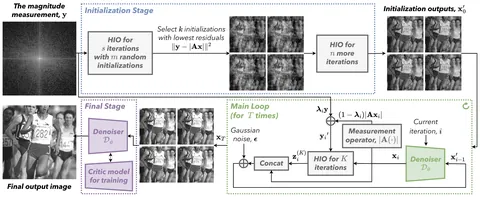
    prNet: Data-Driven Phase Retrieval via Stochastic Refinement

    M. Onurcan Kaya, Figen S. Oktem

    Langevin-based phase retrieval: parallel stochastic reconstructions are averaged (MMSE) or merged by an adversarial network for better perceptual quality.

  9. Digital Signal Processing 2026EUSIPCO 2025 · Oral

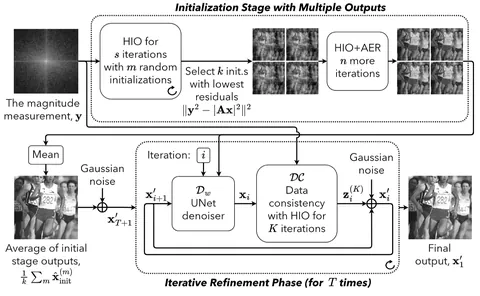
    I2I-PR: Deep Iterative Refinement for Phase Retrieval using Image-to-Image Diffusion Models

    M. Onurcan Kaya, Figen S. Oktem

    An image-to-image diffusion model iteratively refines several initial estimates from classical algorithms, instead of starting from noise.

  10. Applied Optics 2025

    DDRM-PR: Fourier Phase Retrieval Using Denoising Diffusion Restoration Models

    M. Onurcan Kaya, Figen S. Oktem

    Alternating projections combined with a pretrained diffusion prior (DDRM), with no supervised training; tested on simulated and experimental data.

Background

  1. 2024–2027

    PhD in Computer Science · DTU, Denmark

    Teaching assistant for two deep learning in computer vision courses. Supervised 6 MSc theses; 2 became papers (VAR search, AutoQ-VIS).

  2. 2022–2024

    Deep learning & computer vision engineer · Kuartis, Turkey

    Developed perception systems for wide-area surveillance and for autonomous cars and boats: object detection, segmentation and long-range depth estimation on color and infrared images, from data collection to deployment with TensorRT.

  3. 2022–2024

    MSc in Electrical Engineering · METU, Turkey

    GPA 4.0/4.0. Thesis: “Data-Driven Phase Retrieval using Deep Generative Models”, with Figen S. Oktem.

  4. 2021–2022

    Research & teaching assistant · EPFL, Switzerland

    Adversarial robustness of image classifiers with diffusion-based preprocessing.

  5. 2017–2021

    BSc in Electrical Engineering · METU, Turkey

    Valedictorian: ranked 1st among 2,831 bachelor's graduates. Graduation project: “Computer Vision-Based Entrance Security System”.